Insurance Valuations vs. Market Value: Commercial Building Appraisals in Perth County
Commercial real estate owners in Perth County run into a recurring puzzle at refinancing, renewal, or insurance placement: why does the insurance valuation on a building differ from its market value, sometimes by a wide margin? The two figures serve different purposes and follow different logic. Understanding those differences helps owners make better coverage decisions, argue tax assessments with evidence, and avoid avoidable surprises at claim time or loan underwriting.
I have spent years watching this play out across Stratford, St. Marys, Listowel, Mitchell, and the townships in between. In one file, a tidy light industrial building near the 401 corridor sold for less than the cost to rebuild. In another, a brick mixed‑use building on a walkable main street had a market premium driven by tenant demand and limited supply, even though its replacement cost was moderate. If you own or manage commercial https://daltonatho993.almoheet-travel.com/choosing-the-right-commercial-building-appraisers-in-perth-county-a-complete-guide space here, the distinction between insurance value and market value is not academic. It influences premiums, loan proceeds, financial statements, and investment decisions, every year.

What each valuation is really asking
An insurance valuation asks a simple question with complicated inputs: if this building suffers a covered loss tomorrow, how much would it cost to repair or replace it with materials and standards of like kind and quality, including demolition, debris removal, and soft costs? The goal is indemnity, not investment return. Insurers focus on building improvements and fixtures, not land. They also want to understand any coinsurance requirements, code upgrades, and local construction realities that could inflate costs beyond catalogue numbers.
Market value asks a different question: what would a typical, knowledgeable buyer pay for the property today, as of a specified date, given prevailing market conditions, reasonable exposure time, and normal financing? Market value considers the whole fee simple interest, which includes the land. It is anchored by what comparable buyers and sellers have shown they are willing to pay or, for income properties, by the present value of expected net income.
Both values are legitimate, but they rarely match. In a rising construction cost environment, the insurance value often exceeds market value for older or functionally obsolete buildings. In hot submarkets with tight supply, especially for well‑located retail or flex properties, market value can exceed insurance value because buyers pay for location, tenancy, and perceived scarcity, not just walls and roof.
Perth County context matters
Perth County is not Toronto, and the national averages rarely tell the whole story here. Several local forces shape both insurance and market valuations:
- Construction costs have climbed steadily since 2020, with materials volatility and trades availability affecting time and price. For typical low‑rise commercial in the county, current replacement cost new often falls in the range of 200 to 375 dollars per square foot, depending on class, height, and finishes. Specialized facilities can swing far higher.
- The labour pool is tight. Even if you can source materials for less, schedules stretch, which affects contractor overhead, general conditions, and escalation allowances.
- Smaller downtown cores in Stratford, St. Marys, Listowel, and Mitchell have heritage façades and character interiors that cost more to restore than to replicate with modern materials. Code upgrades after loss, especially for life safety and accessibility, can add 10 to 25 percent to insurance values if not already compliant.
- Land is not created equal. Industrial parcels with good access to Highways 7, 8, or 23 carry premiums compared to fringe locations with lower utility capacity. That land value never enters an insurance replacement figure, but it strongly affects market value.
- Tenant demand is lumpy. Food production, small logistics, farm‑adjacent service firms, and medical users have grown footprints. Asking rents that were 10 to 12 dollars per square foot triple net in 2018 can underwrite at 14 to 18 dollars today for new or well‑renovated stock, which lifts market value for stabilized income properties.
These details are why owners lean on local expertise. Commercial building appraisers in Perth County see enough files in the area to recognize when a national cost service needs to be adjusted, or when a sales comp from a neighboring county does not translate.
How appraisers separate insurance value from market value
The toolkits overlap, but the weights differ.
For insurance valuations, the cost approach dominates. The appraiser develops replacement cost new or reproduction cost new, then applies physical depreciation as appropriate to set the right coverage strategy. For insurance, we usually build out several line items that significantly change the final figure:
- Direct hard costs tailored to construction type, height, and quality class.
- Indirect costs for design, permitting, site supervision, and general conditions.
- Demolition and debris removal, often 5 to 10 percent of hard costs for moderate buildings, more for heavy masonry or fire‑damaged structures.
- Code upgrade allowances if bylaws require bringing undamaged areas up to current standards after a partial loss, sometimes handled as an ordinance and law endorsement with sublimits.
- Escalation for expected inflation during a realistic reconstruction schedule, often 12 to 24 months.
For market value, all three classic approaches can matter, but income and sales comparison usually lead. On a single‑tenant industrial, income capitalization with a market lease rate, vacancy, and a cap rate rooted in recent sales provides a clean estimate. On owner‑occupied or specialty properties, sales comparison with local adjustments by size, age, and utility rings true. Cost approach may set a floor or crosscheck, but seldom controls the conclusion unless the market has thin data.
On commercial land, the logic flips again. Insurance values do not include land. Market value does, so land appraisals require parcel‑by‑parcel attention to zoning, frontage, servicing, excess land or surplus land status, and permitted density or coverage. That is where commercial land appraisers in Perth County spend their time, because one zoning nuance can add hundreds of thousands of dollars of value even if the building itself has not changed.
A few grounded examples from the county
Consider a 35,000 square foot food‑grade processing building near Listowel. It was built in 1998 with insulated panels, heavy power, sloped floors, and specialty drainage. The market for similar facilities is tight. As an income property, with a strong covenant tenant paying 17 dollars per square foot net, the market value lagged the insurance value five years ago. In 2025, the relationship reversed. Construction inflation pushed replacement cost, including process piping and food‑grade finishes, to the 350 to 400 dollars per square foot range. Yet cap rates compressed only modestly. The insurance valuation sits around 13 million for the building and machinery that would be included in a replacement scenario, while the market value, including land, trails closer to 11 to 12 million depending on remaining lease term. A loss event on that property would cost more to rebuild than a buyer would pay for the going concern.
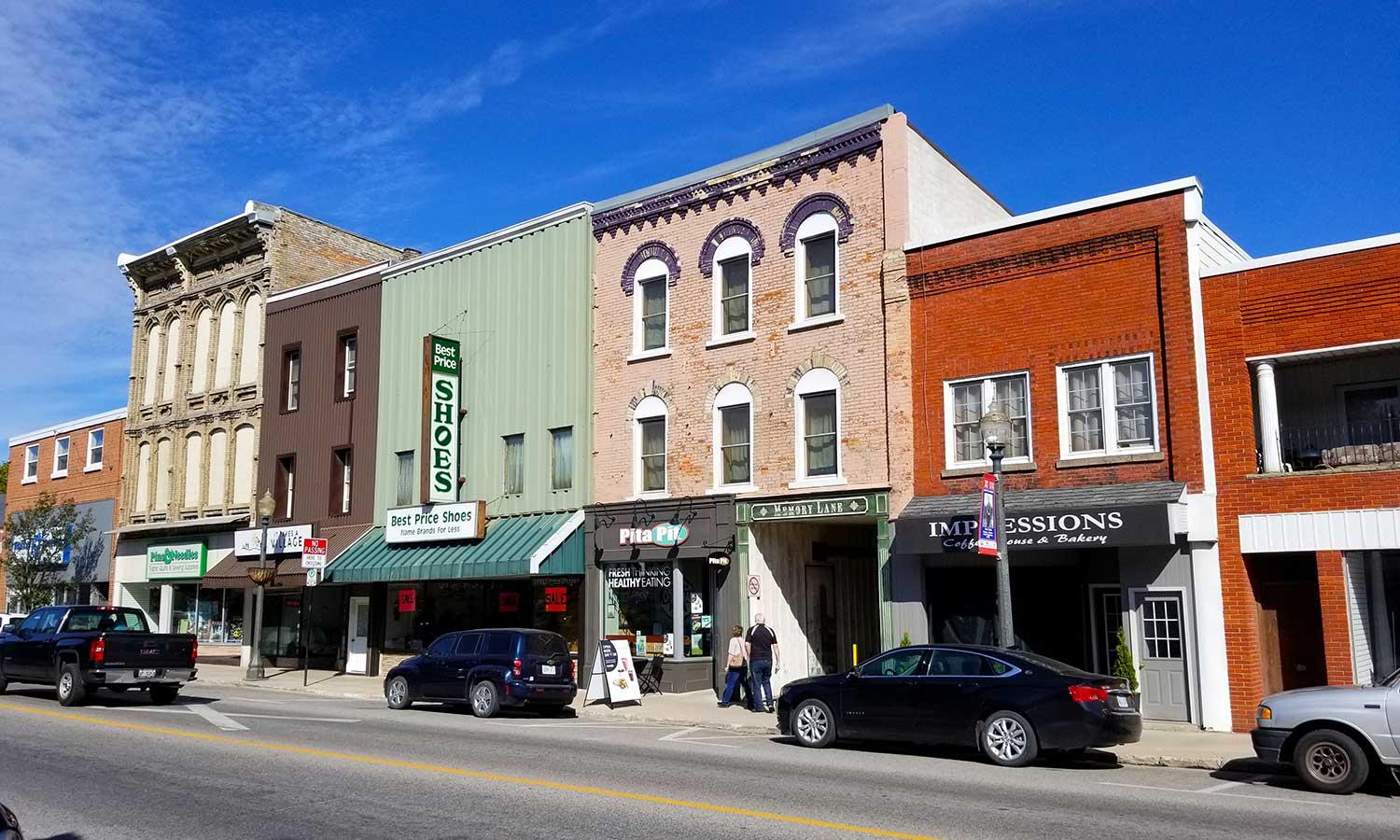
Now flip to an 8,500 square foot mixed‑use brick building on a main street in Stratford with ground‑floor retail and two floors of apartments above. The replacement cost for like kind and quality, even acknowledging masonry and cornice work, may land near 275 to 325 dollars per square foot for the building portion. Yet multiple buyers bid up similar properties because of walkability, tourist traffic, and limited supply. Sales at 400 to 500 dollars per square foot of gross building area are not unheard of. Market value can exceed the insurance estimate, not because it costs that much to build, but because the income profile and the location command a premium.
A third case, common around the edges of the county, involves legacy industrial shells with low clear heights and deep floor plates that do not fit modern logistics. Replacement cost new seems high, but functional obsolescence, awkward loading, and power constraints drag market value below cost. In such cases, setting insurance coverage at full replacement can be counterproductive if the owner would not rebuild that exact function after a loss. A functional replacement concept, where a modern equivalent with different design is assumed, can right‑size coverage. It takes careful dialogue among the owner, broker, insurer, and appraiser to document that choice.
Where misalignment causes problems
The biggest issues arise when a figure built for one purpose gets used for another. A loan officer might read an insurance valuation and ask where the land and market comps went. A broker might lean on a municipal assessment to peg coverage, even though the commercial property assessment in Perth County aims at tax equity, not reconstruction cost. Both moves increase risk.
Coinsurance penalties also blindside owners. If a policy carries a 90 percent coinsurance clause and the building is underinsured, a partial loss can trigger a painful calculation. For example, if the true replacement cost is 5 million and the policy limit is 3 million, the minimum required to avoid penalty is 4.5 million. A 1 million loss would be paid out based on the ratio of 3.0 to 4.5, which is two thirds, less deductible. That is not a theoretical problem. We have seen it happen on roofs and electrical rooms where owners assumed they had plenty of limit.
Another recurring pitfall is ignoring ordinance and law coverage. Older mixed‑use buildings without full sprinkler coverage or with grandfathered stair widths may face large code upgrade costs after even a small fire. Without a specific endorsement, the base policy may not cover bringing undamaged areas to code. Appraisers flag this in insurance valuations, but it takes a broker and client to set proper sublimits.
The role of commercial building appraisers in Perth County
Local commercial building appraisers bring pattern recognition and source networks to both types of assignments. They know which industrial sales in Kitchener or Woodstock translate to Listowel, and which do not. They know which national cost services consistently understate regional labour premiums for masonry trades. They also know which municipal officials are strict on site plan triggers that could force extra work in a rebuild.
Owners often ask whether to use the same firm for both market and insurance valuations. There is value in continuity. A firm that completes a commercial building appraisal in Perth County for financing already has measurements, construction type, age, and some building systems data on file. They can pivot to an insurance valuation more efficiently. On the other hand, insurance assignments require specific cost modelling tools and an eye for soft costs and code issues. Make sure your provider shows that competency, not just market comps.
When land value is a major driver, especially for redevelopment plays or parcels with surplus land, commercial land appraisers in Perth County are essential. They will map frontage, depth, easements, stormwater constraints, and zoning in a way that underwriters and investors can rely upon. Market value lives or dies by that analysis, while the insurance valuation will intentionally leave it out.
How municipal assessment fits in, and where it does not
Owners receive annual notices based on the province’s assessment cycle. These values flow into property taxes, which shape net operating income and, by extension, market value. But the assessed value is not designed to mirror either market value today or replacement cost new. It is a mass appraisal at a valuation date set by the province. If you need to challenge your assessment, evidence from a commercial property assessment in Perth County can help, but you must align your arguments to the assessment framework rather than a lender’s appraisal or an insurer’s cost estimate.
Appraisers often reconcile assessed values to observed market sale prices for context. But I would not base your insurance limits on a tax assessment any more than I would use an insurance estimate to argue your taxes.
What drives the cost side in 2025
Reconstruction cost has several moving parts that changed sharply over the past few years:
- Project duration inflation. Even when material prices stabilize, permit queues, engineering lead times, and trade availability stretch the build, which raises general conditions and overhead. For a straightforward 20,000 square foot tilt‑up, tack on four to six months over historic norms. That alone can add 5 to 8 percent to soft costs.
- Building code evolution. Energy performance, accessibility, and life safety upgrades are not optional in a rebuild. Expect envelope and mechanical systems to step up, even if you do not change the building alike for like. We have seen 10 to 20 percent swings based on code alone.
- Specialty systems. Food‑grade, medical, and light manufacturing buildouts involve stainless, non‑slip sloped floors, redundant power, and process plumbing. National cost books often understate these. A local contractor’s budget can be a better anchor than a generalized model.
- Debris and hazardous materials. Older buildings may hide asbestos, lead paint, or unknown fill. Demolition and abatement drive costs and schedules. Insurers want to understand potential ranges, not just a clean scenario.
A thorough insurance valuation in this environment reads like a project plan. It spells out the assumptions, lead times, and inclusions. Owners should review those assumptions with their broker and their preferred contractor so that everyone shares the same map before a loss.
When insurance and market values pull in opposite directions
Several edge cases recur around Perth County:
Heritage façades on functional shells. The street view screams character, but behind the façade sits a relatively simple shell. The façade alone can be costly to restore. A reproduction cost that preserves heritage elements may exceed what a buyer would pay for that property if vacant, but the income profile and civic pride keep owners committed. Document the reproduction versus replacement choice with your insurer. It changes the number dramatically.
High land fraction sites. Corner retail with generous parking in Stratford or service commercial along a busy corridor might have land worth 40 to 60 percent of the total asset value. A fire does not destroy the land. Insurance does not rebuild land. The market value, however, reflects that location premium. Expect a large spread between the two figures, and do not chase an insurance value up to match market.
Functionally obsolete industrial. Shallow truck courts, too many interior columns, or 12 foot clear heights limit modern use. Replacement cost is one number. A rational owner would not rebuild that exact footprint. A functional replacement at a smaller or reconfigured size might serve the business better. Insurers will price coverage to your documented intent. If you would not rebuild, say so and insure accordingly.
Choosing a valuation partner
Perth County has several qualified firms that focus on commercial and industrial work, and a handful of regional groups that know the county well from nearby bases. When you screen commercial appraisal companies in Perth County, align the assignment to their strengths. If you need a market value for financing, review their recent sales and cap rate work in the county. If you need an insurance valuation, ask about their cost data sources, how they account for code upgrades, and whether they include soft costs with realistic durations. Firms that routinely complete a commercial building appraisal in Perth County should be comfortable showing local references.
Your broker can be a useful guide. They see which insurers accept which appraisers without additional underwriting scrutiny. Lenders will also have panels, but do not assume a lender’s market appraisal satisfies your insurance needs. Many owners keep both on file and refresh them on different cycles.
What owners can do before ordering an appraisal
A short, focused preparation can save time and produce better numbers.
- Gather as‑built drawings, permits, and any capital project summaries for the last five to ten years. Even hand sketches help.
- List mechanical and electrical upgrades with dates, especially service size, HVAC type and tonnage, and any specialty systems like dust collection or process piping.
- Share lease abstracts or rent rolls if the valuation involves market value for an income property. Market‑supported underwriting matters more than asking rent anecdotes.
- Flag known code issues or grandfathered conditions. If you plan to address them soon, say so.
- Provide contact details for a contractor who knows the building. A 10 minute sanity check on build times and site logistics can keep the insurance valuation grounded.
How long it takes and what it costs
Timelines vary with scope and access. For a straightforward single‑tenant industrial building, a market appraisal can often be delivered within two to three weeks from site visit, provided data access is smooth. An insurance valuation can be faster if drawings and system details are available, but if the building has specialized fit‑out, expect a similar or slightly longer window to vet costs with local subs.
Fees reflect complexity, not just size. A 15,000 square foot retail box with simple systems may price lower than a 10,000 square foot medical clinic loaded with oxygen lines and backup power. In Perth County, typical market appraisal fees for common industrial or retail properties often fall in the low four figures. Insurance valuations range widely based on detail required, whether a full building‑by‑component model is requested, and whether multiple buildings or a campus are involved.
Renewal rhythms and how often to refresh
Construction costs have not behaved politely these past few years. Leaving an insurance valuation to age for five years invites underinsurance, especially with coinsurance in play. Many owners refresh insurance values every two to three years, with interim indexation based on a mutually agreed cost index. Market appraisals follow a different cadence. Lenders might require new opinions at renewal or when covenants trigger. Owners planning major capital events, such as an expansion or a sale, benefit from pre‑emptive updates, particularly if rents have stepped up or the lease profile has changed.
If you have a portfolio with buildings scattered across the county, consider staggering refresh cycles so you are not hitting every site at once. Your appraiser can build a template that keeps assumptions consistent while tailoring location‑specific inputs like land value, service capacity, and market rent.
A note on evidence and advocacy
Owners sometimes need to defend a perspective. Perhaps a municipal assessment feels too high, or a lender’s out‑of‑area review appraiser misreads the local industrial market. Strong evidence wins these battles. That means sales verified with brokers or participants, rent comps that separate gross from net and capture inducements, and cap rates triangulated by multiple recent trades. On insurance, it means cost evidence tied to drawings, code citations, and contractor input. A high‑quality report from experienced commercial building appraisers in Perth County arms you with credible, local data.
The bottom line for decision‑makers
Insurance value and market value serve different masters. One is about putting a building back, under the pressure of permits, trades, and code, within a timeframe that inflates costs. The other is about what a real buyer would pay, for the land and the building, given rent, risk, and scarcity. In Perth County, those worlds overlap enough to confuse, but not enough to substitute. Treat them separately, hire the right expertise for each, and make the assumptions explicit.
Do that, and you will set coverage that performs when it must, justify financing on terms that reflect your market, and sleep better knowing that your biggest line items, taxes and insurance, are anchored in reality rather than hope.